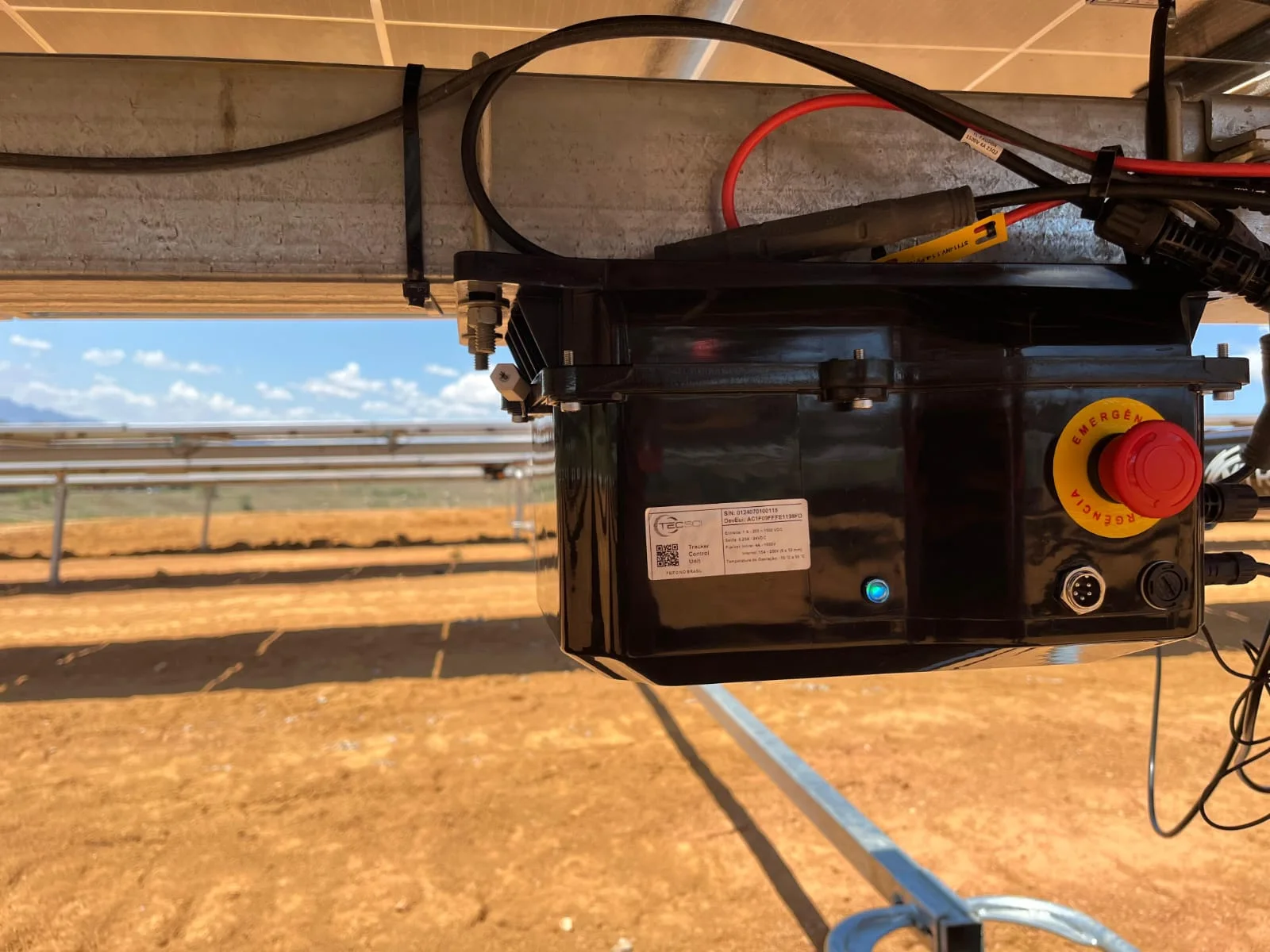
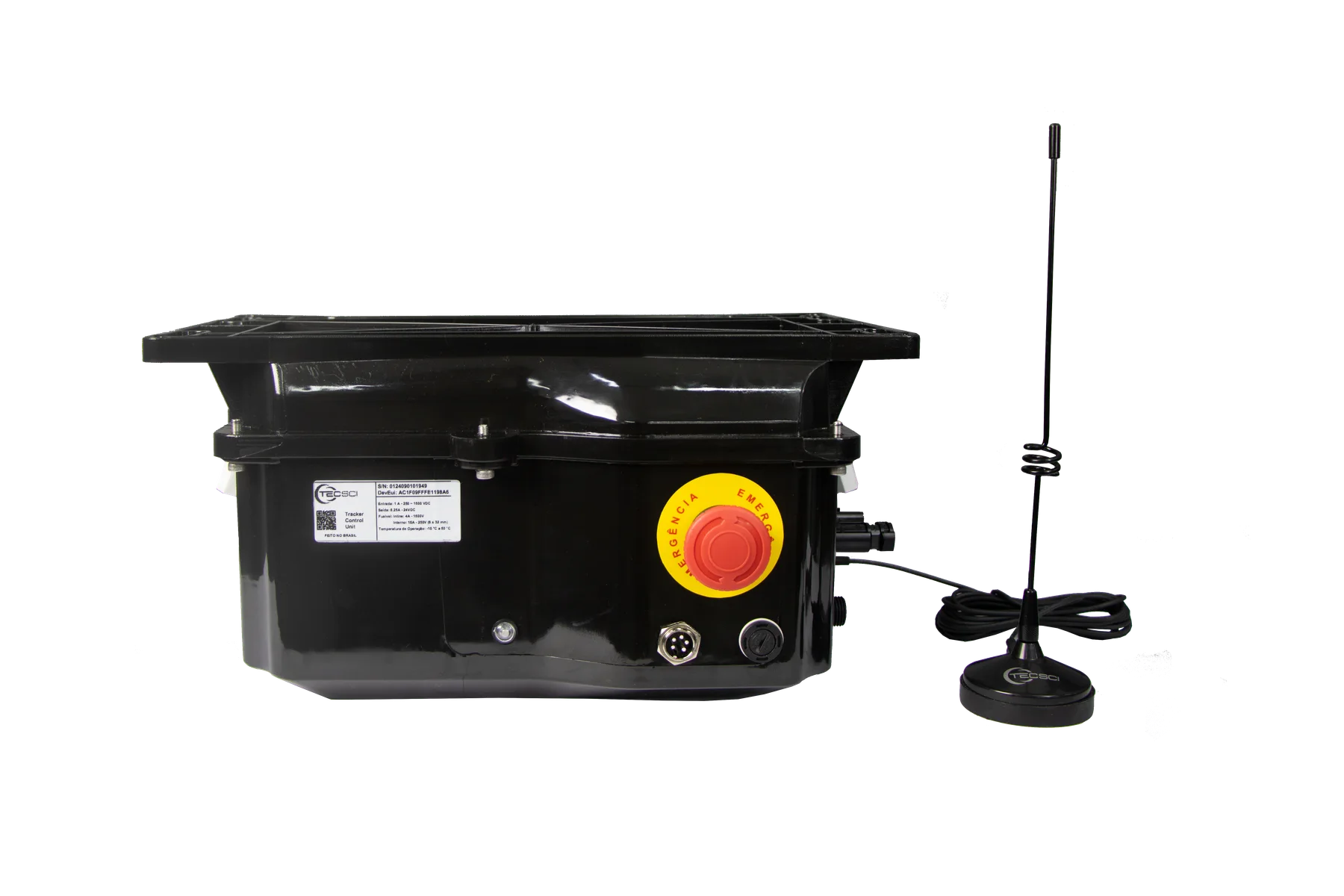
TCU
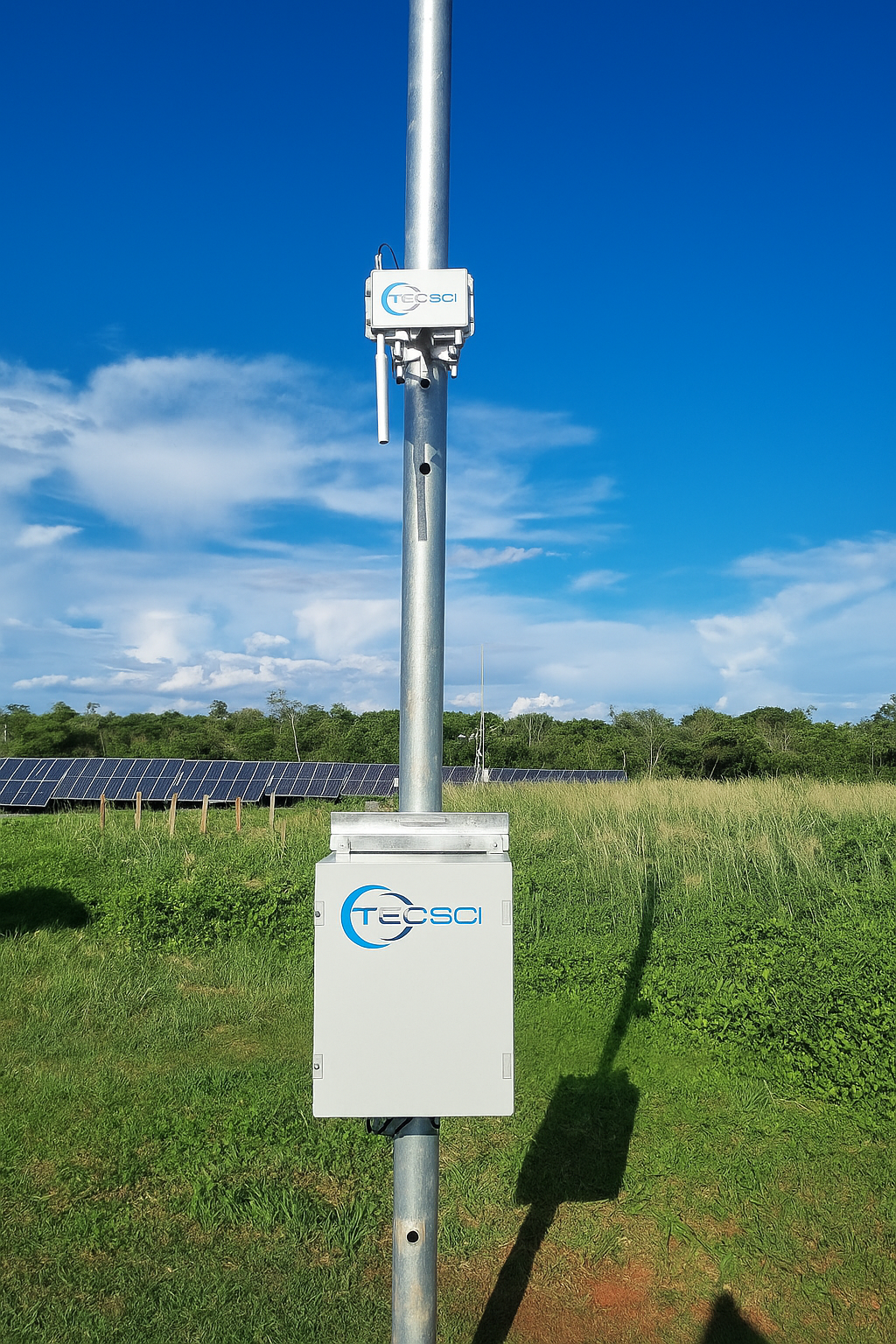
Tracker-mounted unit for motor, position and local safety control.
Tracker Control System
Solar tracker control at scale: precise positioning, fleet protection and the TrackBoost intelligent mode built into the tracking.
TECSCI product · Tracker control
Complete architecture
From weather readings to TCU commands, every layer turns operating context into safe movement.
Tracker-mounted unit for motor, position and local safety control.
Field communication designed for a distributed fleet.
Tracker supervision and commands included in the ecosystem.
Intelligent mode that turns weather, geometry and history into new position targets.
Commissioning, commands and remote diagnostics with confirmation of the TCU’s actual state.
Open integration and continuous supervision: it compares expected and actual state and fixes discrepancies when automatic correction is enabled.
NCU Web · Local SCADA
NCU Web is the fleet command center: a local SCADA installed on the NCU and included in the Tracker package. Any device connected to the NCU network can operate the fleet — no cloud required.
NCU Web is the local SCADA for the tracker fleet — it is not the Monitoring platform, an independent product for performance and portfolio management. Explore Monitoring
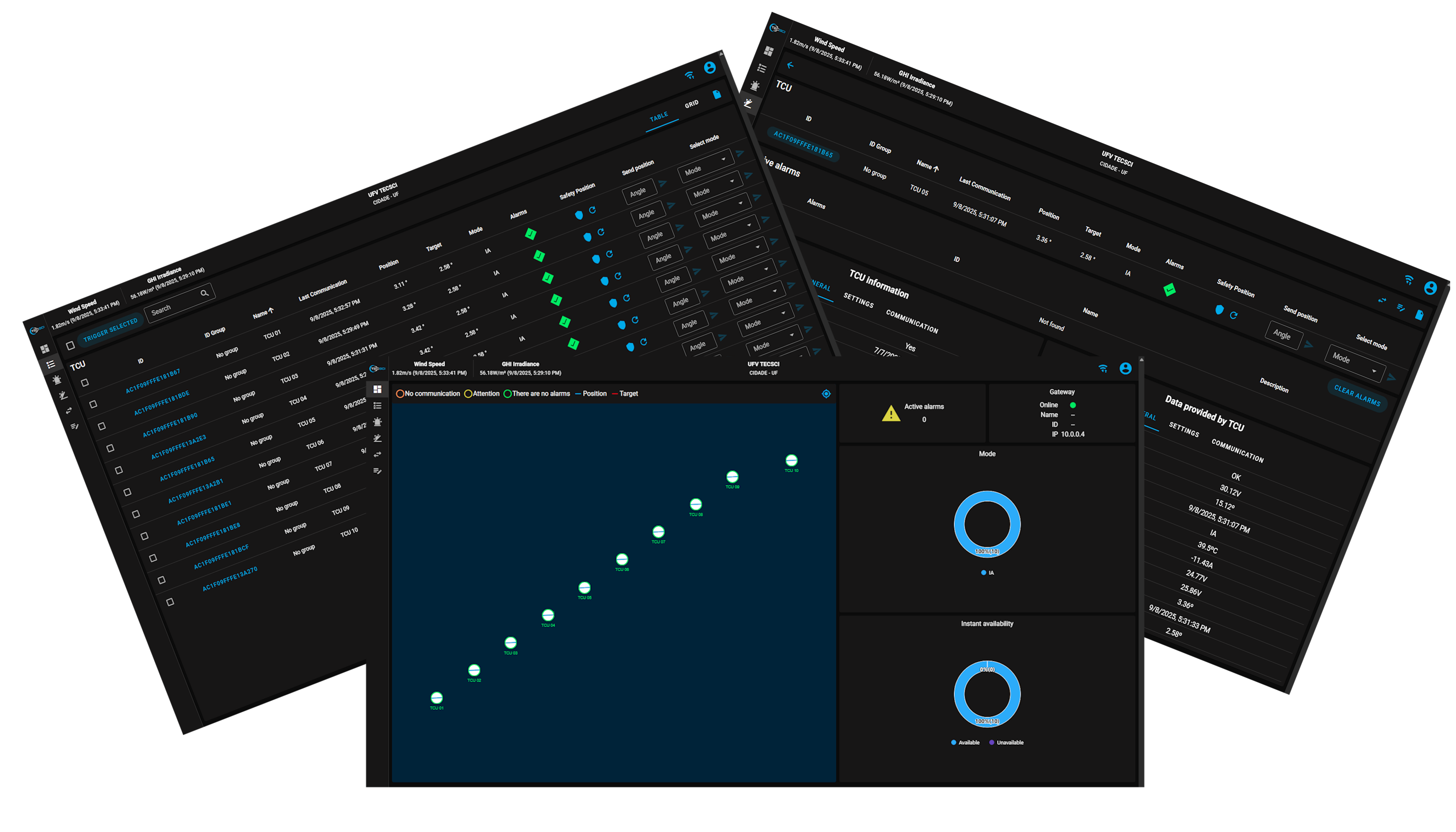
Confirmation and remote diagnostics
Through the app, the team can see what is truly stored and happening in each TCU — position, target, sensors, alarms, events, command queue, history and configuration profiles — without traveling to the field.
The app and API record the command and configuration that each TCU is expected to maintain.
The TCU returns its operating state and the parameters actually stored in firmware.
The API identifies differences between the configured values and the actual state received from the field.
When automatic correction is enabled, only the required adjustments are sent to synchronize the TCU.
The API verifies configurations, safety positions and clocks. When automatic correction is enabled, it fixes discrepancies and keeps the fleet consistent and healthy.
Hardware · NCU NCS-500
Tracker intelligent mode
TrackBoost is the AI mode built into TECSCI Tracker. It combines local weather conditions, plant geometry and operating history to recalculate fleet position targets — keeping intelligence, commands and movement in one system.
Irradiance, temperature, wind and operating history feed the strategy.
TrackBoost compares current conditions with geometry and terrain to reduce shading and clipping losses.
The NCU coordinates the fleet and sends recalculated position targets over the field network.
Each TCU moves its tracker in real time while respecting mechanical limits and local protection rules.
The intelligent mode optimizes generation while operation remains inside the safe range. Local alarms, mechanical limits and the house-shaped safety position at 15 m/s override every optimization target.
Progressive wind protection
Before the critical limit, the TCU progressively narrows the angular window and keeps tracking inside the safe range. At 15 m/s, the fleet immediately assumes the commissioned house-shaped safety position.
The tracker follows the sun with backtracking and active mechanical limits.
The movement range narrows while safe generation continues.
The window becomes tighter and preserves only permitted angles.
The rows leave progressive tracking and form the house position defined during commissioning.
The NCU anemometer reports conditions and the API selects the configured level for each TCU.
Separate entry and exit thresholds prevent oscillation when wind stays close to a level boundary.
The TCU clamps its target to the safe range and continues following the sun within it.
The critical limit takes priority over dynamic levels and sends the fleet directly to the safety position.
7 programmable safe positions
See the complete wind response: the 3D sandbox demonstrates progressive protection and the immediate house position at 15 m/s.
Open the interactive demoSafety autonomy
Safety intelligence lives in the TCU firmware, in the field. If the network fails, every tracker keeps protecting itself.
After 2 h without downlink (configurable default), the TCU autonomously assumes the configured wind safety position.
End stop, overcurrent, stalled axis and inclinometer directly trigger the safety state on the TCU.
Configured plant geometry guides positioning to reduce row-to-row shading.
Over-the-air firmware updates via LoRaWAN multicast for the entire fleet, with dual-bank safety to roll back if needed.
Each unit has its own battery and solar panel, with voltage and current monitoring.
Active protection
Protection combines continuous readings, progressive tracking windows and the house-shaped safety position at the critical limit.
Use the time control to follow the solar arc and observe coordinated positioning.
The NCU monitors wind and distributes the appropriate protection level to the fleet.
Before the critical limit, the angular window narrows while tracking continues in the safe range.
At the critical limit, rows immediately assume the commissioned safety position.
The TCU preserves safe behavior even when connectivity changes.
Tracker Control System
Robust installation, assisted commissioning and an interface that turns signals into action.
Solar tracker guide
Following the sun is mechanics. Delivering the expected gain every day is software running in the field — row by row, with the wind blowing.
A solar tracker is the structure that turns the modules through the day to follow the sun and capture more irradiation than a fixed structure. In ground-mounted plants the dominant format is single axis, rotating the rows east–west.
A single-axis tracker rotates around a horizontal axis, usually north–south, with one actuator per row. A dual-axis tracker also adjusts tilt to follow the sun's elevation: it wins at high latitudes, but adds moving parts, maintenance and failure points that the control system has to monitor.
Early in the morning and late in the afternoon, the angle of maximum capture makes one row cast a shadow on its neighbour. Backtracking moves the fleet away from the purely astronomical target to reduce that loss — and it is a software decision, taken in every controller.
Positioning, protection and the return to the safe position happen in the field, controller by controller. Without local sensing, reliable communication and autonomy in every tracker, the tracking gain is lost to shading, alarms and unplanned downtime.
Common questions
A solar tracker is the structure that follows the sun's movement to capture more irradiation than a fixed structure. In ground-mounted plants the most common format is single axis, rotating the rows east–west.
Yes. “Solar tracker” is the English term and “seguidor solar” is the Portuguese one: both describe the same moving structure that follows the sun.
The gain varies with latitude, cloud cover and plant geometry, so there is no single number. What decides how much of that potential becomes generation is positioning accuracy through the day, correct backtracking and fleet availability — exactly what the control system delivers.
Backtracking is the correction that moves rows away from the angle of maximum capture to keep one row from shading the next, which happens with a low sun, early in the morning and late in the afternoon. Without it, part of the tracking gain is consumed by row-to-row shading.
Each row has a controller that executes the position target, reads its own state and applies local protection rules — the TCU at TECSCI. The coordination layer, NCU Web, distributes targets, consolidates telemetry and keeps the plant visible to operations, with local SCADA and Modbus integration.
The tracker has to leave the operating position before the critical wind speed, at a speed compatible with the expected gust. That protection must run in the controller itself, without depending on the cloud: anemometer, wind-speed stow curve and autonomy to bring the fleet to the safe position even with the network down.
Yes. Both technologies coexist, including in expansions of plants that started with fixed structures. What changes is operations: the mobile fleet needs its own telemetry, alarms and history to be managed as a separate asset.
TECSCI portfolio
Purchase each solution independently and combine tracker control, electrical automation and plant management to match your operation.
01Tracker controlField TCU, network, TrackBoost, NCU Web as local SCADA and commissioning application.
You are here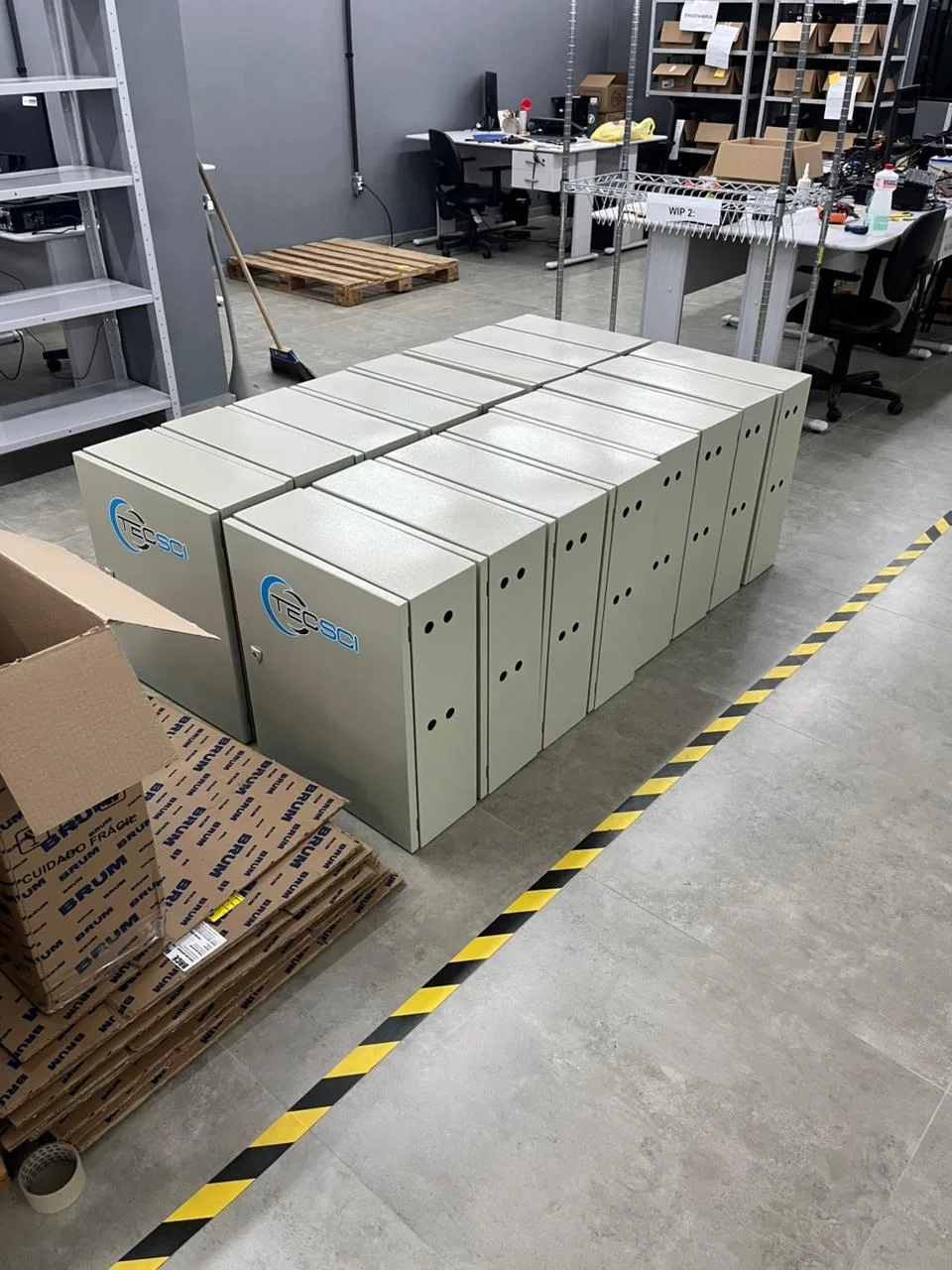 02Electrical automation
Remote reset, telemetry and industrial integration to reduce travel and downtime.
Explore the Panel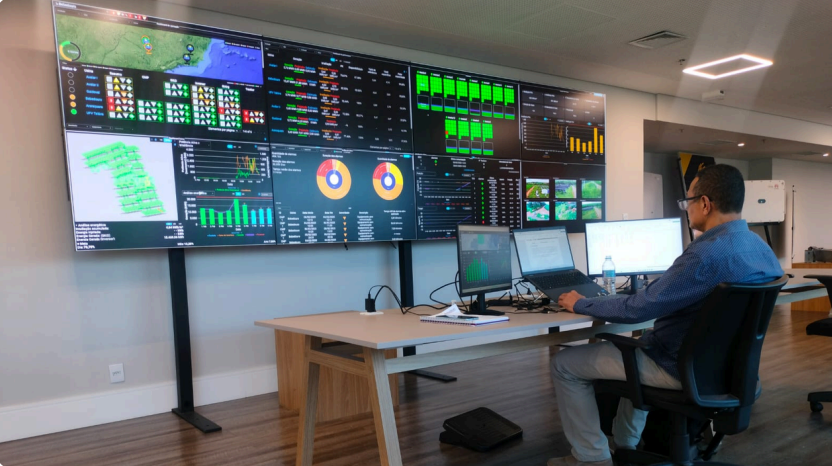 03Independent platform
Performance, alarms, maintenance and multi-plant management in one web environment for any plant.
Explore Monitoring